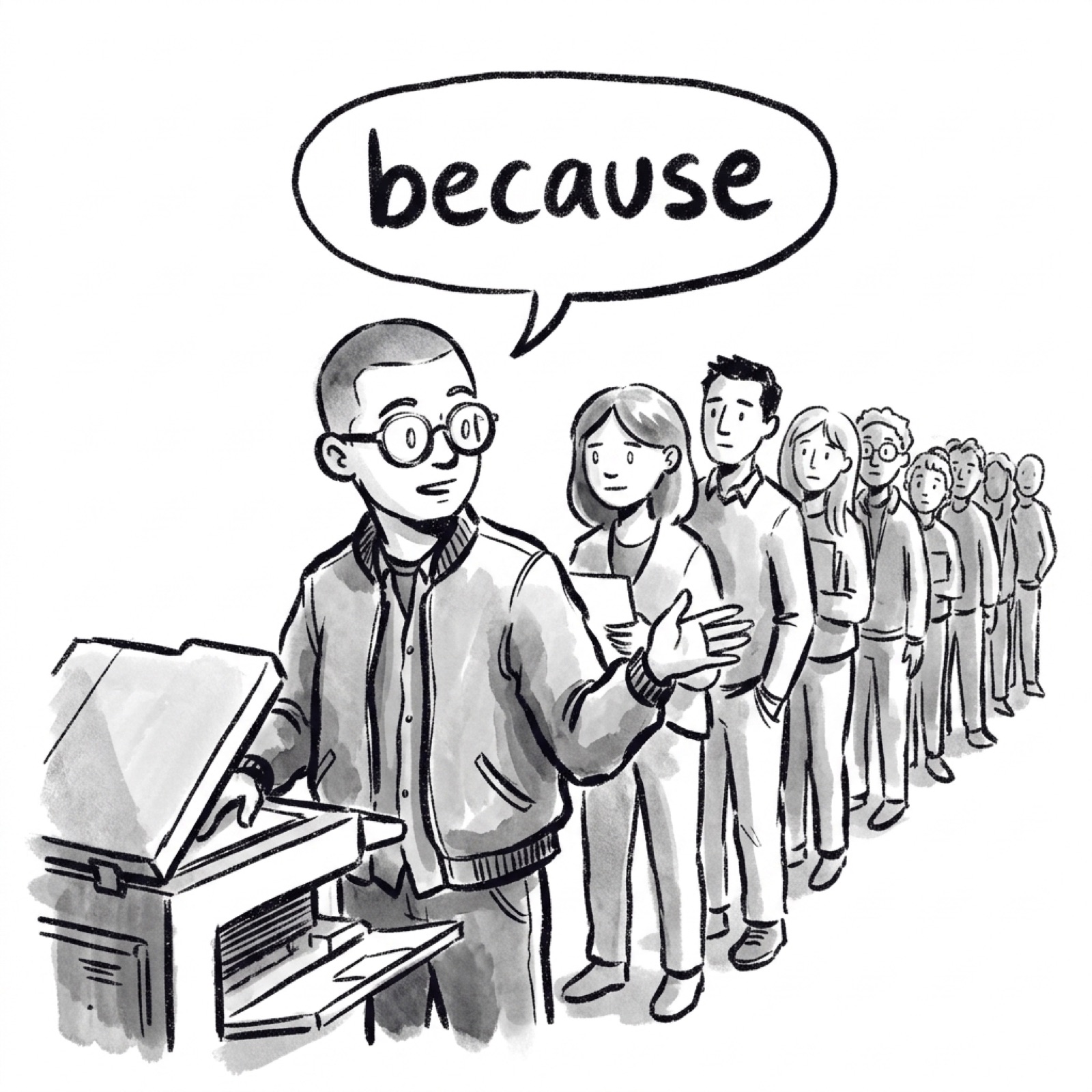
In 1978, psychologist Ellen Langer and colleagues Arthur Blank and Benzion Chanowitz walked up to strangers waiting to use a copy machine at Harvard and asked to cut the line, testing three versions of the same request. They published the results in the Journal of Personality and Social Psychology under the title "The Mindlessness of Ostensibly Thoughtful Action."
The plain ask, "Excuse me, I have five pages. May I use the Xerox machine?", worked 60 percent of the time. Adding a real reason, "because I'm in a rush," pushed compliance to 94 percent. Unsurprising. People say yes more when you give them a reason, which is why every paywall has a line of copy under the price. The surprising part is what happened next.
The Reason Didn't Have to Say Anything
Langer's team tried a third script: "May I use the Xerox machine, because I have to make copies?" Read that sentence again. It gives no new information. Everyone in a copier line is there to make copies. It is a circular, empty statement dressed up as a justification.
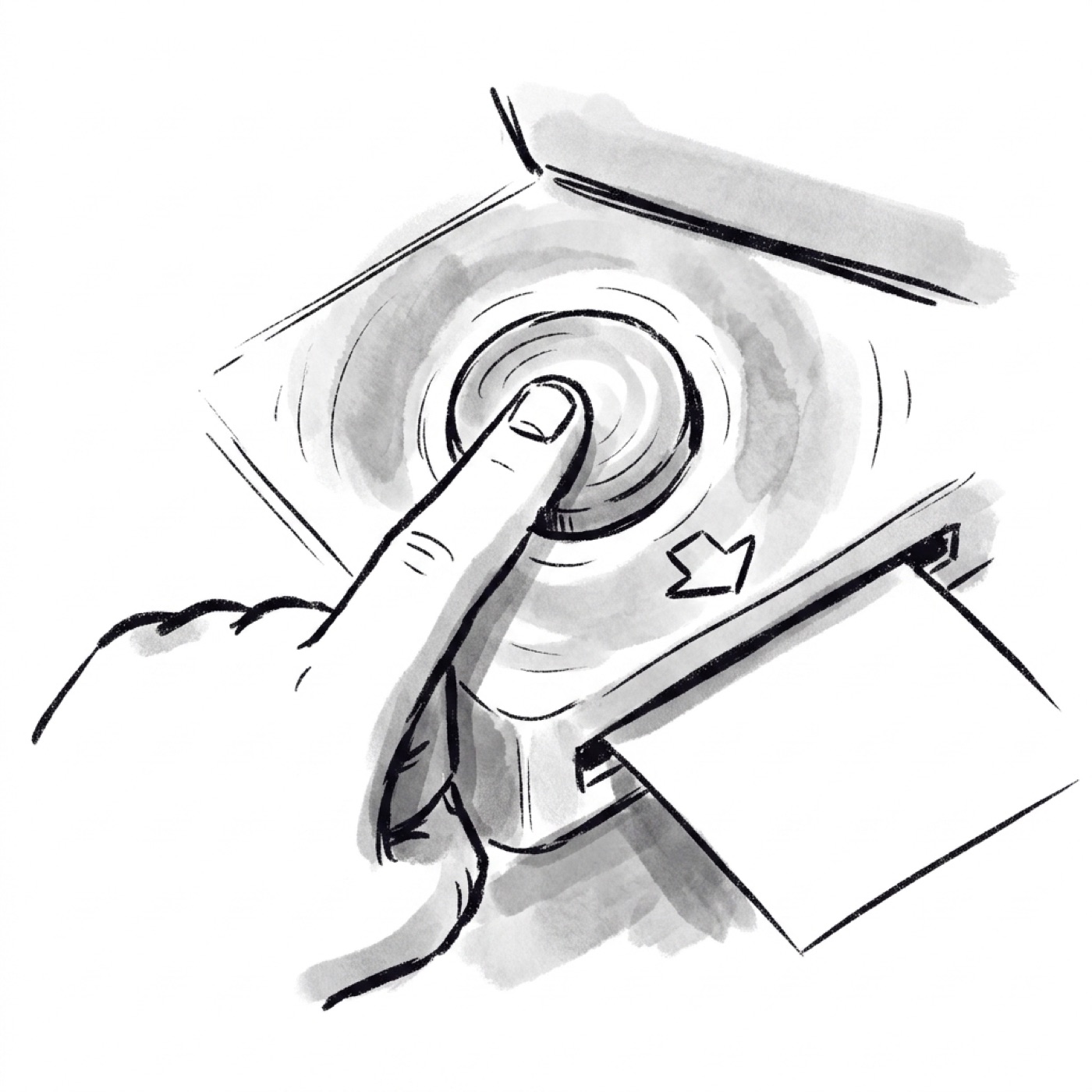
That empty reason still worked. Compliance hit 93 percent, almost matching the genuine reason at 94 percent and far above the 60 percent baseline with no reason at all. Researchers later called this kind of content-free justification placebic information, a reason that looks like a reason but explains nothing.
The word "because" did more work than the actual content of the sentence that followed it.
This is the detail that makes the study famous outside academic circles. Robert Cialdini cites it in his bestselling book Influence as a clean demonstration of a broader rule: people are more persuadable by the structure of a request than by its substance, at least when the request is small.
Why the Brain Waves It Through
Langer's explanation for this pattern was mindless compliance. For small, low-effort requests, people are not weighing the merits of your reason. They are pattern-matching. The word "because" signals "a justification is coming," and that signal alone is often enough to trigger a yes, because stopping to evaluate a trivial request costs more attention than it's worth.
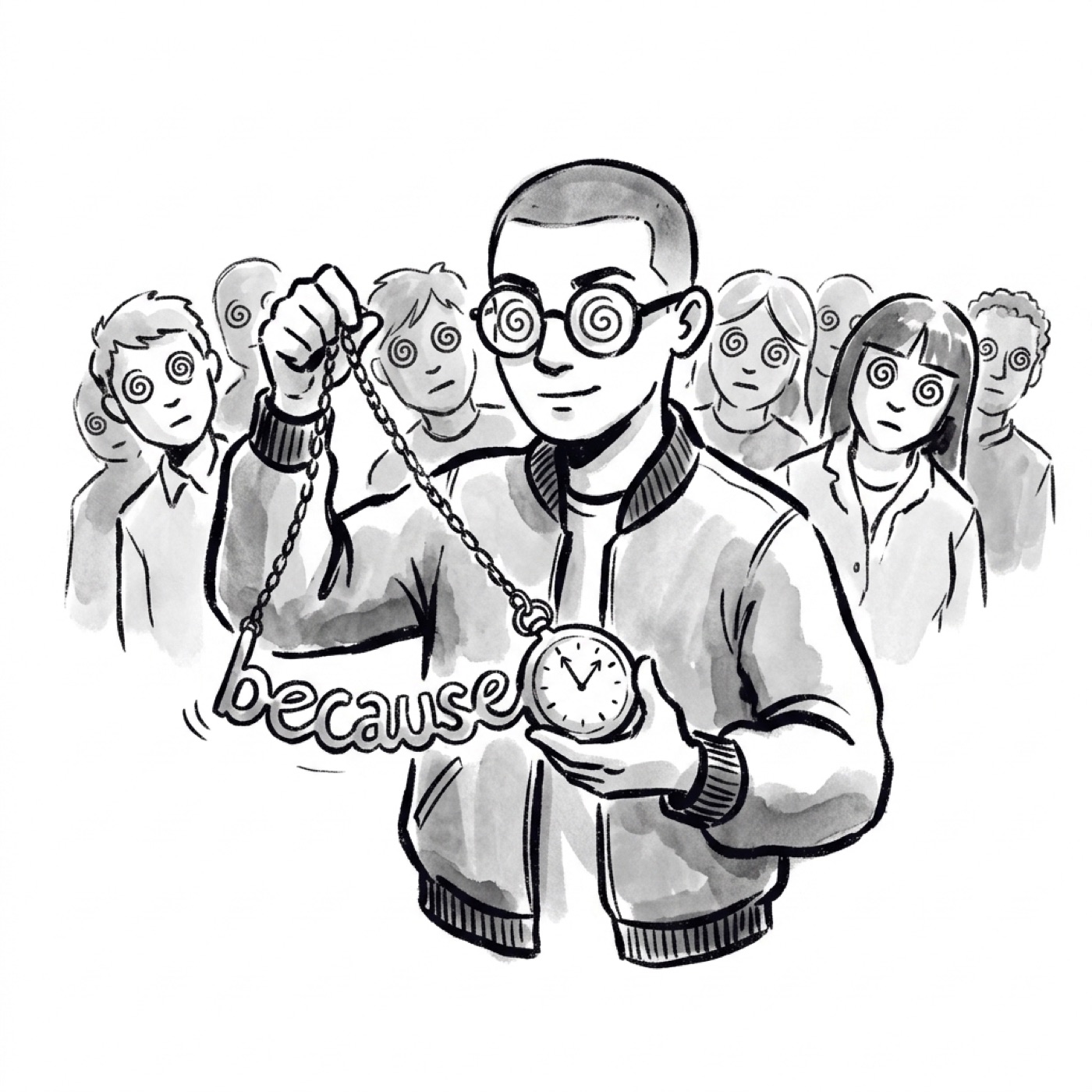
This is not people being gullible. It is people being efficient. Nobody has the bandwidth to run a cost-benefit analysis on every micro-request they encounter in a day, so the brain runs on shortcuts, and "because" is one of the most reliable ones in the English language.
For a product manager, this reframes a lot of UX copy decisions. A permission prompt, a form field, a paywall screen, and an upsell modal are all, structurally, the same kind of small request Langer studied. The user is being asked to do something. The question is whether you hand them a reason or make them supply their own, and their own reason is usually "no."
The Ceiling: When the Trick Stops Working
The study did not stop at the easy case. Langer's team reran the experiment with a bigger favor, asking to cut in with a large stack of copies instead of five pages. This time the placebic "because" collapsed. It produced no meaningful lift over asking with no reason at all. Only the genuine reason, "because I'm in a rush," still moved people, and even that dropped to 42 percent compliance, down from 94 percent on the small request.
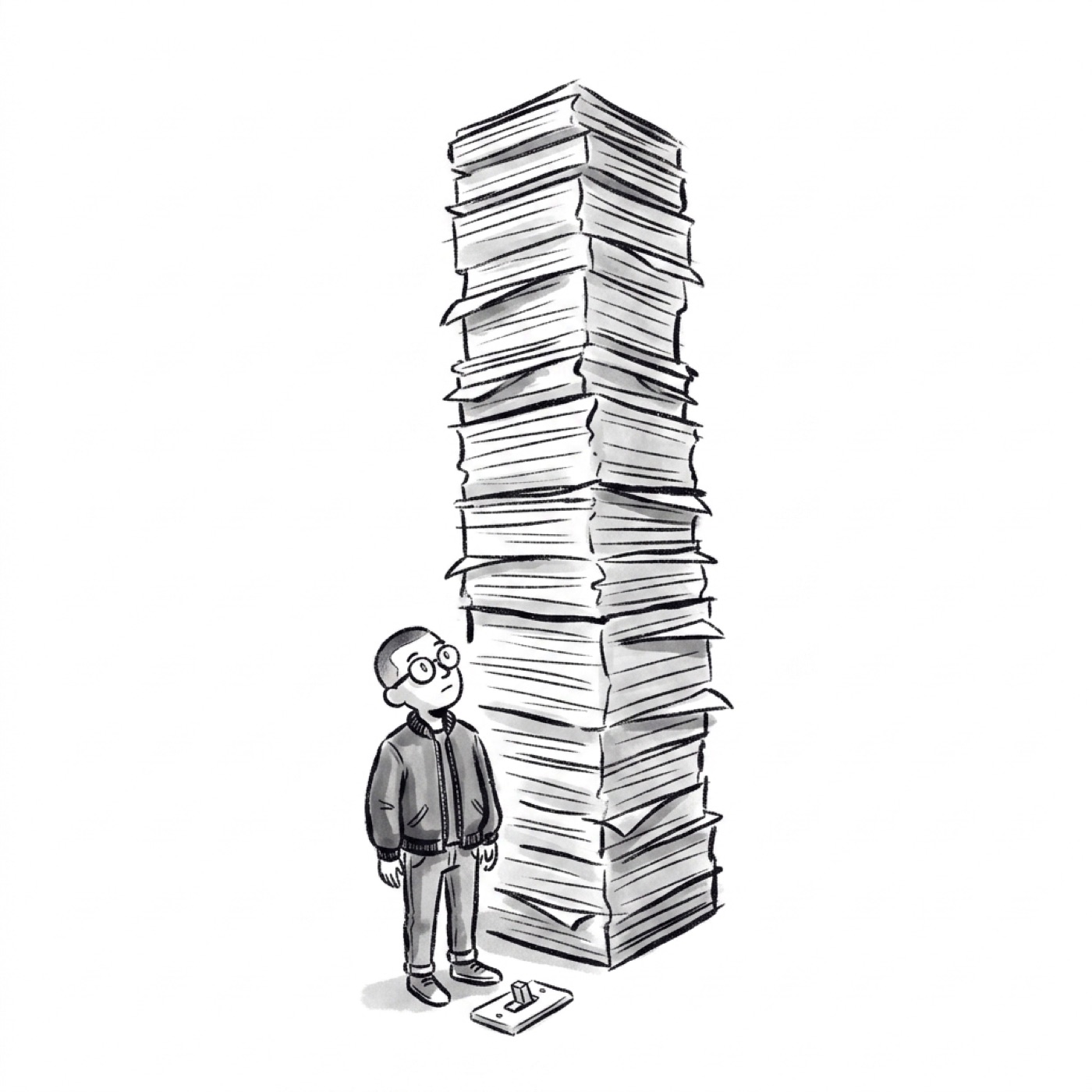
The pattern flips once a request gets costly. When people have something real to lose, mindless compliance shuts off and they actually read the reason. A hollow "because" that sailed through on a low-stakes ask gets seen through immediately on a high-stakes one, and no amount of confident wording rescues it. This is the part of the study most retellings skip, and it is the part product managers most need.
A Modern Version of the Same Trick, at App Store Scale
Langer ran her experiment on a few hundred people at one library. Product teams run a version of it every day at app-store scale, through App Tracking Transparency (ATT), Apple's system-level prompt asking users to allow or deny tracking.
Apple's own popup is fixed, so developers cannot rewrite the request itself, only what happens right before it: a "pre-permission" screen explaining, in the app's own words, why tracking is being requested. According to 2025 benchmark data from the mobile measurement firm Adjust, the industry-wide ATT opt-in rate sits around 35 percent. Apps that run a well-designed pre-permission screen before the system prompt report average opt-in rates closer to 65 percent, roughly double the baseline.
That gap is the same mechanic Langer found in 1978, running at product scale: a stated reason, delivered right before the ask, changes the yes rate dramatically. Apps that fire Apple's default prompt with no context are, in Langer's terms, asking without a "because." The ones that explain the benefit first hand users a reason before they invent their own, and their own is almost always "deny."
The lesson also carries the study's second half. ATT is a real privacy decision with a real cost to some users, so a vague pre-prompt ("we'd like to improve your experience") underperforms a specific one ("we use this to stop showing you ads you've already seen"). Placebic reasons work on copier lines. They work less well when the ask involves someone's personal data.
Where This Shows Up in Your Product
Every screen that asks a user for something is a candidate for this pattern, and most PMs can audit their own product for the gap in about ten minutes.
- Permission prompts. Precede the system dialog with one sentence naming the specific benefit, not a generic "to improve your experience."
- Paywalls and upsells. "Upgrade to Pro" converts worse than "Upgrade to Pro because your team hit the 3-seat limit."
- Data collection forms. A phone number field with no explanation gets abandoned more than one labeled "so we can text you when your order ships."
- Onboarding steps. Any step that asks for effort before delivering value needs a reason attached, or users assume there isn't one.
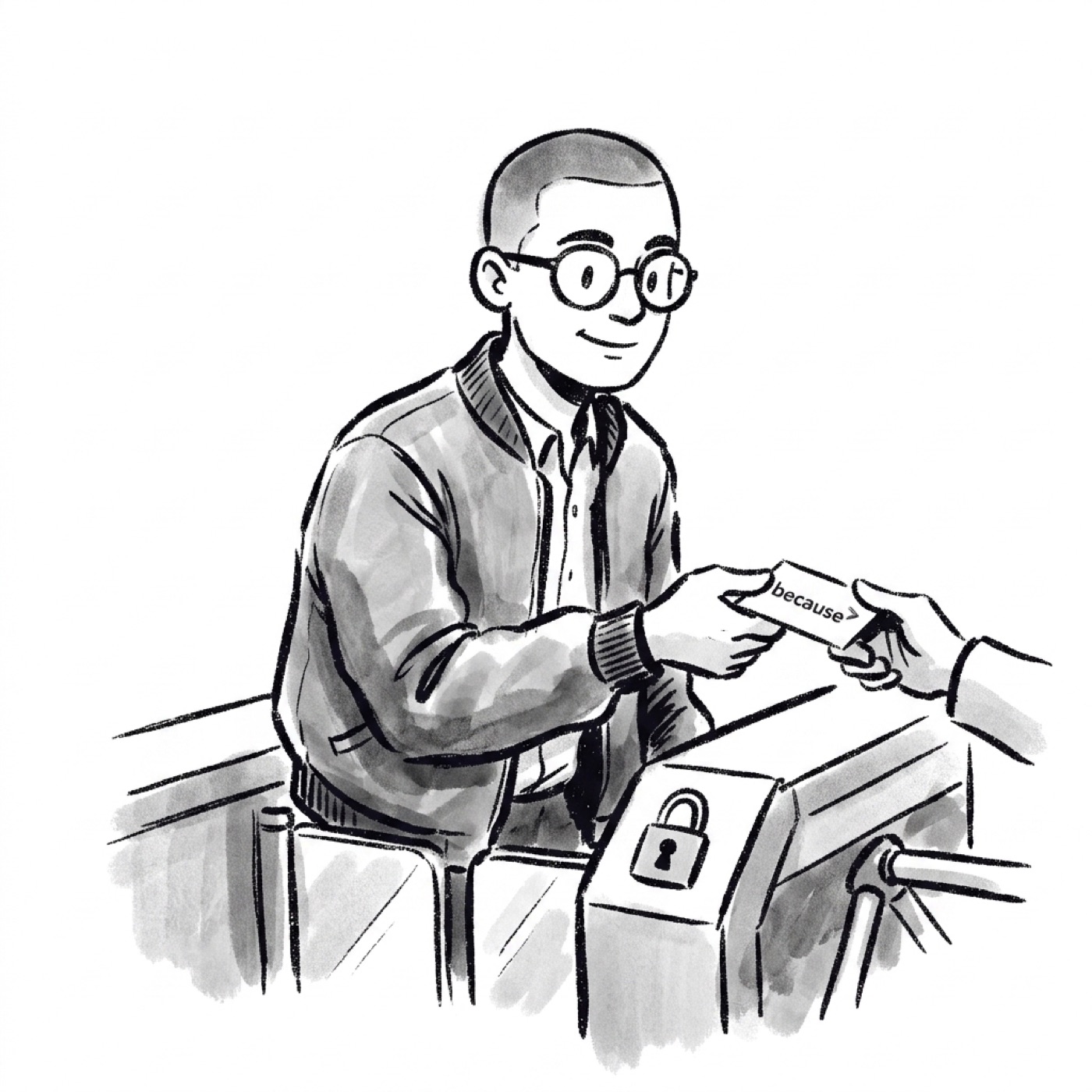
The common mistake is treating this as a copywriting nicety instead of a functional requirement. Teams ship a permission prompt, watch opt-in numbers disappoint, and rewrite the button color, when the actual defect is that nobody wrote a reason at all. The subtler mistake is the one Langer's large-request condition warns about: reaching for a placebic "because" on a high-stakes ask. "We need your card details because we need your card details" is a real pattern in checkout flows, and on anything that costs the user money, time, or privacy, it reads as manipulation, because by that point the user is paying attention.
The fix scales with the stakes. Low-stakes ask, like a cosmetic notification permission: almost any honest reason lifts your numbers, closer to Langer's 93 percent condition. High-stakes ask, like billing information or broad data access: the reason has to be genuinely strong and specific, closer to her 42 percent condition, where only the real explanation still worked.
How to Apply This
- Find every screen in your product that asks a user for something (a permission, a field, a payment, an upgrade) and check whether it states a reason at all.
- For low-stakes asks, add any honest, specific reason. The bar is low, but "no reason" is worse than almost any reason.
- For high-stakes asks (payment, broad permissions, sensitive data), write a reason that would survive the user reading it twice. Vague or circular reasoning gets seen through here.
- A/B test the reason itself, not just the button. The Langer study's real finding is that the justification, not the design polish, moved the number.
- Revisit prompts you shipped without a stated reason first. That is usually the single highest-leverage rewrite on the page.
Every product decision is, underneath the UI, a request for a small yes. If you want to get better at reading what actually moves people to say it, on either side of the table, allthingspm.app has 4,000+ mock PM interviews to practice with, lets you run a mock interview from a real job description, and reviews your resume against a JD.
References
- Langer, E., Blank, A., & Chanowitz, B. (1978). "The Mindlessness of Ostensibly Thoughtful Action." Journal of Personality and Social Psychology, 36(6), 635-642. (scan)
- James Clear: "Why We Act Irrationally: A Harvard Psychologist Reveals the One Word That Drives Our Senseless Habits"
- Human Factors International: "Just Because"
- Psychology Today: "The Power of the Word 'Because' to Get People to Do Stuff"
- The Ladders: "Harvard's most persuasive word might just be a scam"
- Adjust: "ATT opt-in rates: 2025 data & benchmarks"
- Playwire: "Mastering IDFA Opt-In Rates: The Complete AppTrackingTransparency Guide for iOS Apps"